In conversation….
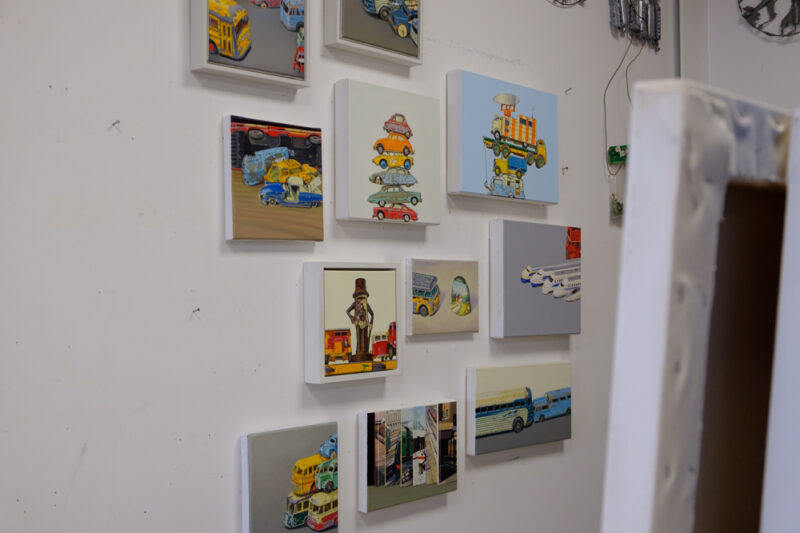
Visiting Jeremy in his studio is like going back in time. I always had a load of Matchbox and Hot Wheels cars as a child and to this day am quite obsessed with cars. I’d make them race each other and crash into each other and ramp over each other. Inevitably, they’d be quite worse for wear after a very short period but that just added to their coolness. Jeremy has taken his passion for these cars and built an incredible career out of it. Showing his works all over the world. I posed a series of questions to him to find out more:
1. Firstly, why cars?
The ongoing project with toy cars started back in 1997 when a friend in the US sent me a nicely repainted but well played with Greyhound bus he’d picked up at a fleamarket. I started to use it in some still life paintings and then added a few of my own from childhood to the groupings. I had kept them in a box in the studio but up to that point it had never occurred to me to use them as subjects. I was an obsessive toy car collector/player as a child so they all had a story to them.
2. When did you realise that this could be a career? (did you ever want to do anything else?)
A bit of luck, really, as it so often is. I had worked for galleries installing other artists’ exhibitions after leaving art college but kept a studio space and went there as often as possible. I showed the work to a few gallerists when I was happy with what I was working on and this resulted in my first exhibition.
3. Your attention to every detail of the patina is remarkable. Most people would gravitate toward pristine cars, whereas you do quite the opposite. Where did your interest in this style come from?
I’m more interested in the story behind each car so I prefer the scratches and dents created mostly by their anonymous previous owners rather than ‘fresh out of the box’ pristine models. I would also prefer to spend a day in a car junkyard rather than a motor show which probably explains a lot.
4. You have a show coming up in an America. Does the demographic dictate the car you paint (So, America would be more muscle car) or do you find people are drawn to all types of cars regardless of where they live?
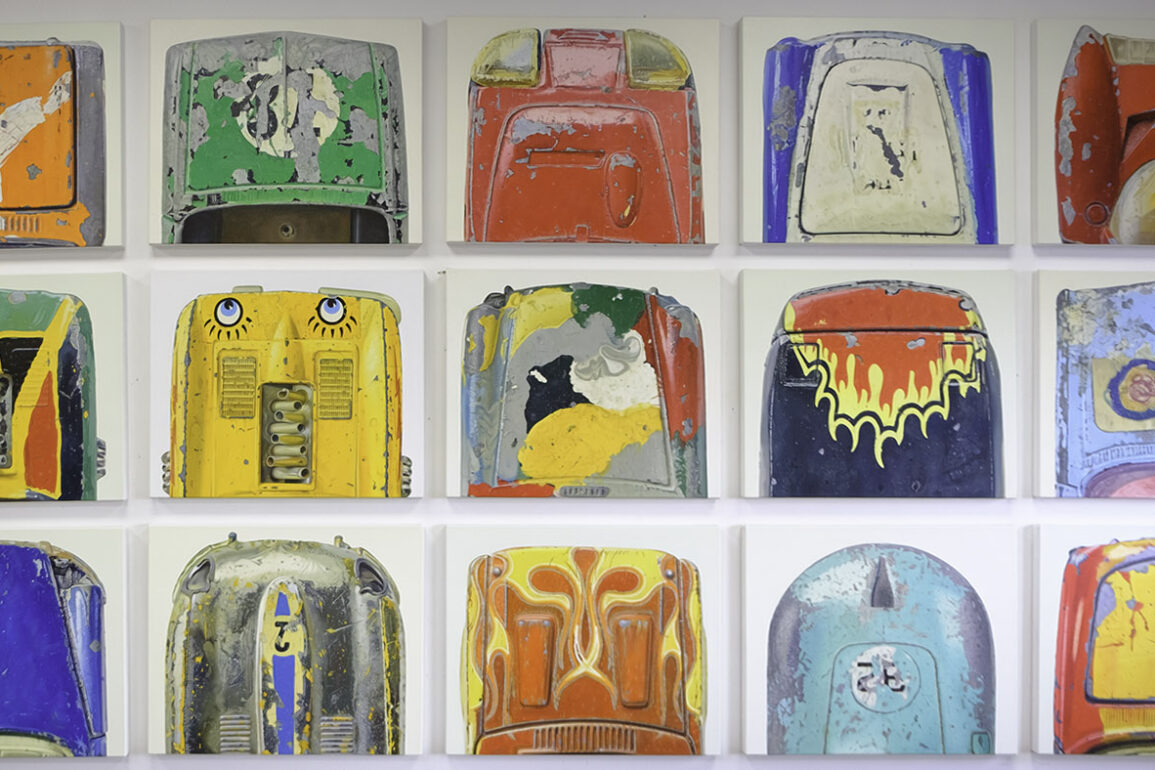
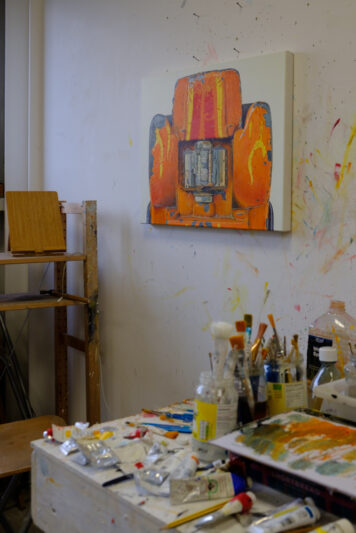
I’m showing a group of car hood paintings at the upcoming Expo Chicago fair. It will be a mix of US, UK and European classics. I find that there isn’t a preference due to demographics. The work seems to generate interest from all ages/genders whether it’s an old Halifax bus or a Mustang car hood painting.
5. Of all the cars you’ve collected over the years, are there any which have been more special?
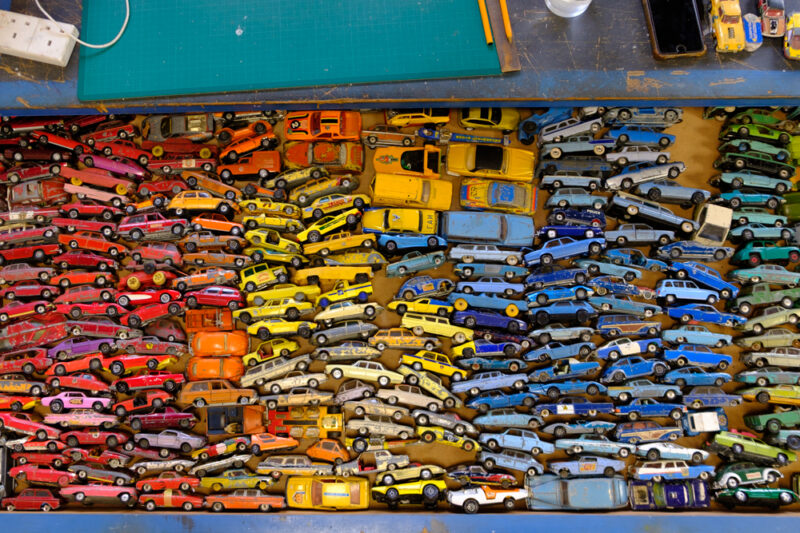
A few in the drawers mean a bit more than others. The Greyhound bus mentioned above of course. I’ve also a Dinky Morris 1100 bought for me by my grandfather as this was the only car he ever drove in real life. I also have the first toy cars my parents played with as young children (my Dad’s Buick and my Mum’s Auto Union racer both from the 1930s). I also still have most of the cars I played with as a child, all inscribed on the base with a green enamel ‘J’ to identify my cars in group play sessions!
6. How have you seen the art world evolve in the time you’ve been an artist?
Social Media of course has had a big effect. It’s a great way to discover other artists around the world whose work you would never have found before. It’s great to have an international audience for the paintings even if I don’t have any exhibitions on at a particular time. The digital world means that photographing work and finding source material are so much easier and less time consuming today. The downside is it’s easy to be distracted when I’m supposed to be concentrating on working in the studio.
7. Is the future bright for the art market with A.I coming into the picture? 8. When you’re not in the studio, what do you like to do?
I hope and I’m sure that there will remain a market for handmade art objects whether painting, sculpture or installations, although AI will have a significant role in assisting in the production of all this. I’m wary of allowing AI into the driving seat to dictate which direction my work should take.

8. When you’re not in the studio, what do you like to do?
When I was at Goldsmiths College I would take most Friday afternoons off and use a Red Bus Rover ticket to explore London. 40 years later, I still enjoy doing this as time off from the studio, although I call it ‘research’! Also happy rummaging around at old toy fairs looking for additions to the studio collection.
10. Finally, if you could have any 3 paintings on your wall at home, what would they be?
This changes over time, but currently I have three favourite painters, whose work I would be very happy to live with:
Altoon Sultan @altoonsultan paints small egg tempora paintings of light on farm machinery found on farms near her studio in rural New England in the US
Jennifer Lee @jenny_j_lee makes small paintings of random imagery sourced on line and painted on coarse canvas so the weave of the fabric interacts with the paint in a very interesting way to create the image.
Cynthia Daignault @cynthia_daignault – check out her series of small paintings of the individual frames of the Zapruder film of the JFK assassination
Limited Edition Prints start at £150