1. Your work primarily explores architecture, landscapes and seascapes. What influences the direction you take?
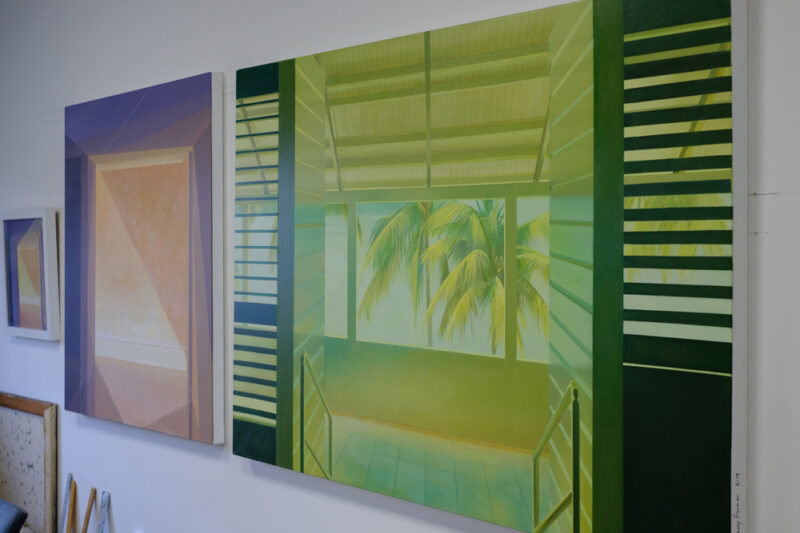
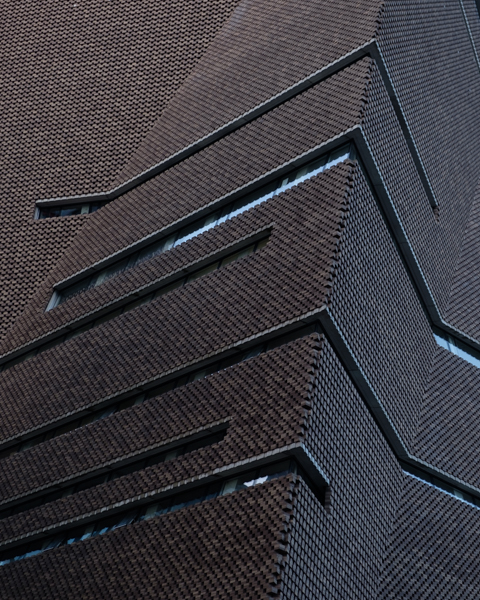
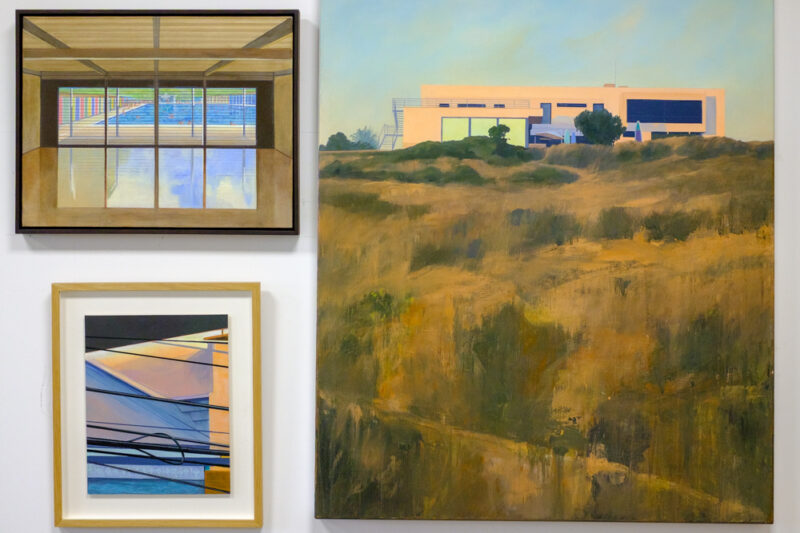
Like a lot of artists, I go through different phases. However, at heart, there is always a strong sense of place / context in my work in which I seek to capture and articulate form, structure, texture, colour and, most importantly, light. Capturing these elements is what drives me but also exploring the overall concept of ‘order versus disorder.’
2. Many of your paintings feel rooted in place. What draws you to particular locations? is it atmosphere, geometry, memory, or something else?
Some locations are familiar and stem from early childhood memories and family experiences in places such as Cornwall, Austria and Portugal. With others, it is the opposite! They are in different parts of the world, including Chile and Peru, which have provided new and exciting subject matter.
2.1 Are they all actual locations or places from your imagination?
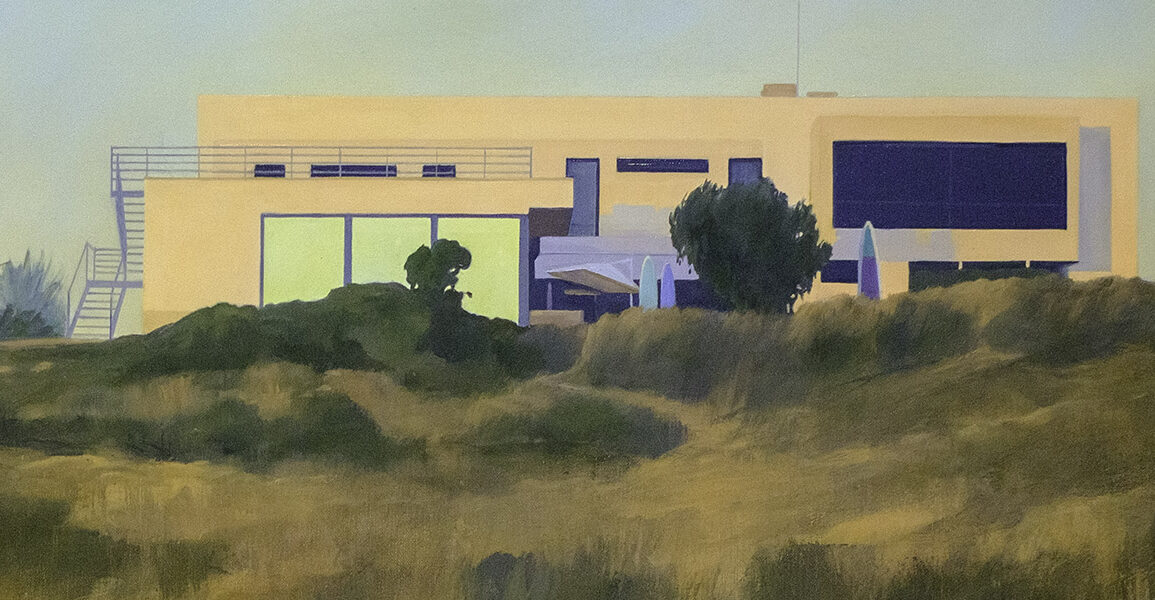
In most cases, the paintings are based upon actual locations but I often reimagine and manipulate the image to create a particular composition that I want to achieve. This is with the aim of adding an element of surprise or of simplifying it to achieve a degree of abstraction.
3. You reference artists like Hockney and Richter; how did you balance their influence with developing your own distinct visual language?
Artists like Hockney and Richter have informed my work but not necessarily overly influenced it. In the case of these two artists, I am fascinated by their artistic journey, and how their processes and techniques have guided their body of work. They are both brilliant draftsman (which I think is pre-requisite to producing great art). I also like the fact that they experiment with different mediums and are not overly restricted by the need to stay on ‘brand’. But that may be as a result of being amongst the most famous living artists in the world and, therefore, they can do what the f… they like!
4. There’s a strong sense of structure and geometry in your work. Do you approach a canvas more like an architect, or is it more intuitive?
As I have progressed as an artist, I realise my approach has become increasingly analytical. I tend to do a lot of research and sketches before committing to canvas. But, at the same time, the steps I take to apply paint and complete a piece are fundamentally intuitive. There is always a level of trial and error and, in oils, I often apply multiple layers of glazes to achieve the tone and depth I want. So I guess it is a combination of very structured, analytical thinking (like a designer or architect) and then intuitive application. I do suffer from occasional creative block and that may be because I sometimes overthink a concept / composition and then get stuck!
5. Light seems to play significantly in your works, How important is light in your practice and how do you think about it? Do you think about it in painterly terms, or almost architecturally as a material in itself?
This is a very interesting question. Without doubt, it is the latter. The common denominator throughout my work is light. I am fascinated by the shapes, patterns, tones and colours it can create on surfaces whether they be solid, translucent or reflective as on water or glass, for example. In composition terms, I am constantly searching for structure, form and texture that allows geometric shapes to sit alongside the organic.
6. Your works seem to be very focussed on serene environments. Is this intentional?
I am not particularly conscious of seeking to project serene environments but it is a comment I often hear made about my work. I am happy for it to be so. If I can create a sense of calm and serenity in the viewer’s mind (especially in these very troubled times) then I hope that will be considered a good thing.
I am very interested by the fact that, psychologically, great art exhibitions are known to release endorphins which helps treat depression. So not all art is useless, as Oscar Wilde said in one of his famous quotes!
At the other end of the scale, I have been considering producing a series of ‘apocalyptic’ paintings, concentrating on the destruction of the built and natural environment. Examples that I have in mind are the devastation caused by the fires in California and the war in Ukraine. But the subject matter may not be very saleable?!

7. Where do you see the relationship between contemporary painting and contemporary architecture today? Are they in dialogue, or operating separately?
Again, this is another interesting question and not an easy one to answer in a few words.
In times past, the great patrons (royalty, the church, and the aristocracy) can often be seen to embrace both architecture and art in their palaces, places of worship, and stately homes.
In today’s terms, it seems to be more driven by state sponsorship and commerce. There are some stunning examples of contemporary architecture providing public spaces for contemporary art and culture.The new UAE Zayed National Museum on Saadiyat Island, designed by Foster+Partners, is a work of art in itself! I could reel off a number of other examples but this is one that springs to mind.
8. If you could own any 3 paintings, what would they be?
Wow – difficult one. My taste is eclectic but probably the Night Watch by Rembrandt, any landscape by Caspar Friedrich and L’Arbois, Sainte Maxine, by David Hockney (or Girl with a Pearl Earring by Vermeer, Betty by Gerhard Richter, Notre-Dame by Matisse).